
Chemotherapy Hair Loss Planning
Cold Cap vs. Wig During Chemotherapy
If you are preparing for chemotherapy, deciding how to handle possible hair loss can feel like one more difficult decision at an already overwhelming time.

For many women, the choice initially sounds simple:
Do I try a cold cap and hope to keep my hair, or do I prepare for a wig?
The appeal of scalp cooling is easy to understand. The possibility of keeping your own hair can feel incredibly important when so much else is changing.
But there is an important difference between keeping some of your hair and having your hair continue to look and feel the way it did before treatment.
At The Hair & Scalp Specialists, we do not provide cold-cap or scalp-cooling treatments. What we do is help women understand what the different paths may realistically look like so they can make a more informed decision before treatment begins.
What Does a Cold Cap Actually Do?
Cold capping, also called scalp cooling, lowers the temperature of the scalp before, during, and after chemotherapy. This reduces blood flow to the scalp and may reduce the amount of chemotherapy reaching the hair follicles.
For some patients, scalp cooling can reduce hair loss. But results vary based on the chemotherapy regimen, dose, cap fit, and the individual. Even with scalp cooling, some shedding is expected, and significant hair loss can still occur.
“Keeping Your Hair” and “Keeping Your Look” Are Not Always the Same Thing
This is one of the most important things we talk about with women considering scalp cooling.
For many women, hearing that they may be able to “keep their hair” creates an expectation that their hair will continue to look much like it does before treatment.
That may not always be the outcome.
Even when scalp cooling helps preserve hair, there may still be thinning, shedding, reduced density, or changes in the way the hair looks and behaves.
The emotional question then becomes less about whether hair is technically still present and more about whether the woman still feels comfortable with what she sees in the mirror.
Sometimes preserving some hair does not feel the same as preserving the version of yourself you were hoping to see.

Cold Cap vs. Wig: Two Very Different Approaches
Neither option is right for every woman. The important thing is understanding what each one asks of you and what each one can realistically provide.
| Consideration | Properly Fitted Wig | Cold Cap / Scalp Cooling |
|---|---|---|
| Main goal | Create a predictable finished look | Reduce hair loss |
| Predictability | Color, length, fit and style can be planned in advance | Results vary |
| During treatment | No treatment-time procedure | Requires active cooling before, during and after treatment |
| Comfort | Materials and fit can be selected for comfort and sensitive scalps | Can feel very cold or uncomfortable |
| Appearance | Designed to recreate a familiar pre-treatment appearance | Hair may still thin, shed or change |
| After treatment | Can continue through regrowth until you are ready to transition back | Scalp cooling ends when treatment ends |
One Is an Active Process. The Other Is an Option You Use When You Need It.
One of the biggest differences is something many women do not fully appreciate until chemotherapy begins.
Scalp cooling requires active participation during treatment. Depending on the system, the cap is worn before chemotherapy, during the infusion and for a period afterward. Some women tolerate this well. Others find the cold, pressure, extra treatment time, headaches or general discomfort difficult — especially as treatment progresses.
A wig asks something very different of you.
You can wear it when you want to go to work, meet friends, attend appointments, go out to dinner or simply look in the mirror and feel more like yourself. And when you are home and comfortable without it, you do not have to wear it.
The Speed of Hair Loss Matters Emotionally
We work with many women who experience gradual thinning unrelated to cancer treatment.
For them, the change may happen slowly over several years — and even that can be extremely difficult.
Chemotherapy-related hair loss can compress that same emotional experience into a matter of weeks.
That sudden change can be difficult whether the hair is completely lost or becomes noticeably thinner than it was before treatment.
This Is Where Predictability Can Matter
A properly designed wig can give a woman the ability to choose what she sees when she looks in the mirror, rather than waiting to see how her own hair responds from week to week.
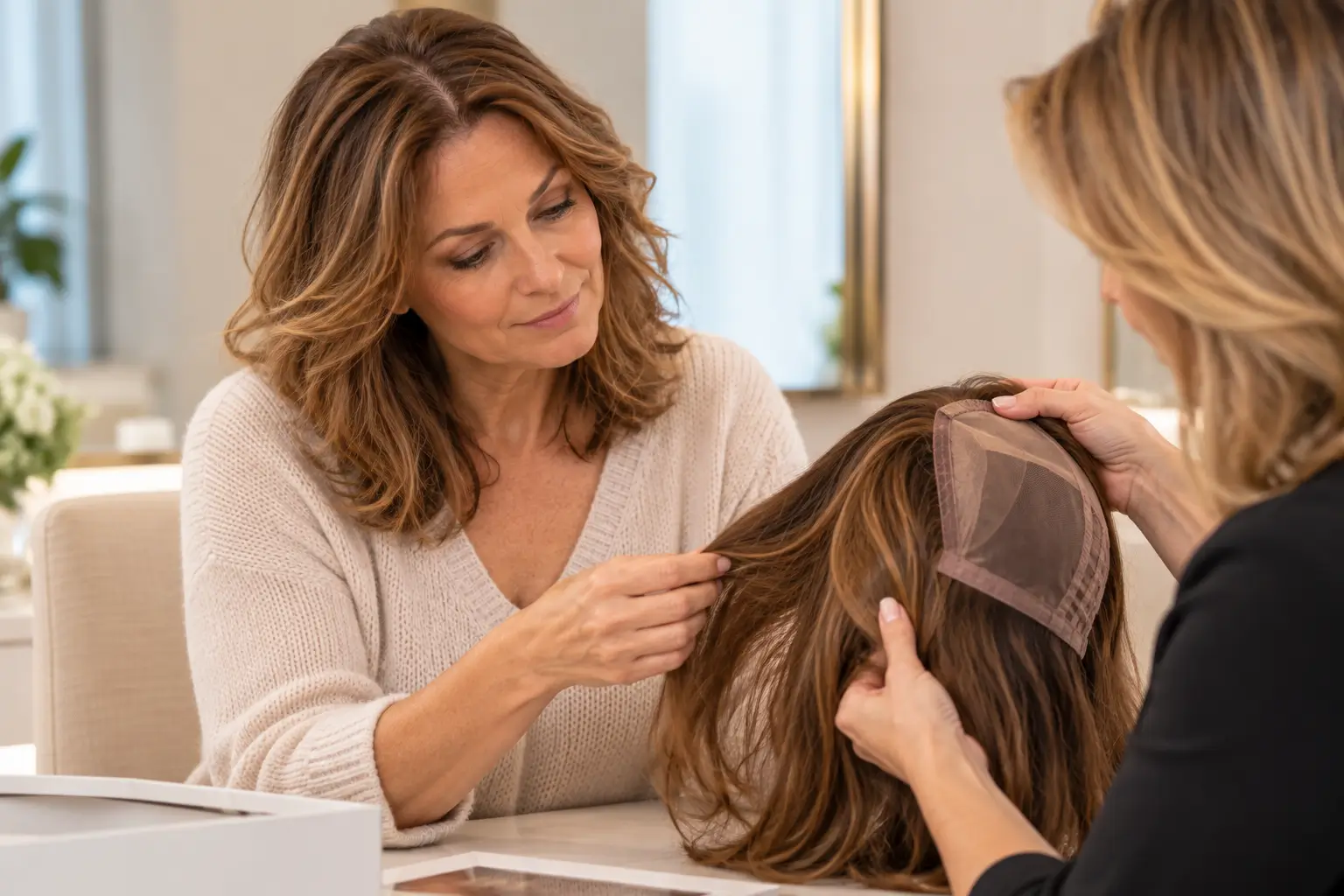
A Wig May Be Very Different From What You Are Picturing
Many women come into a consultation expecting a wig to be hot, itchy, heavy or obviously artificial.
Seeing and touching a high-quality handmade human-hair wig can change that perception very quickly.
During a consultation, you can feel the hair, see the construction and better understand what a properly selected and fitted wig can actually be like.
See the Materials
You can see and feel the cap construction before making a decision.
Feel the Human Hair
High-quality human hair looks, moves and feels very different from an inexpensive synthetic wig.
Plan for Comfort
We can discuss breathable materials and options for scalps that become especially sensitive during treatment.
Why We Prefer to Meet Before Treatment Begins
If you are considering a wig — even as a backup plan — the best time to meet with us is usually before chemotherapy begins.
That allows us to see your hair while it is still healthy and document the details that make it look like your hair:
Our goal is to create the most seamless transition possible from your own hair, through treatment, and eventually back to growing hair.
We have had women return from medical appointments wearing one of our wigs and tell us their doctors or nurses questioned why they had not lost their hair. That is the kind of result we strive for: not a wig that looks like a wig, but a look that simply feels like you.
Want to See What a High-Quality Wig Experience Actually Looks Like?
Learn more about our handmade human-hair wigs, private fitting process, customization and ongoing support for women experiencing medical hair loss.
What If You Try Cold Capping First?
That does not mean you have made the wrong decision.
Some women feel strongly about trying to preserve as much of their natural hair as possible, and we respect that.
What we encourage is planning ahead.
If we meet before treatment, we can document your natural hair and understand your preferences while we still have the best reference point.
Then, if scalp cooling does not give you the result you hoped for, you are not starting the wig process from the beginning. We already have much of the information we need to move toward a solution more efficiently.

A Wig Can Give You a Longer Runway
A wig is not only useful during the period when hair is being lost.
It can continue to support you after treatment while your own hair begins growing again.
That allows you to decide when you are ready to transition back to your natural hair rather than feeling pressured to do so simply because treatment has ended.
So, Is Cold Capping or a Wig the Better Choice?
There is no single answer that fits every woman.
Scalp cooling can reduce chemotherapy-related hair loss for some patients, and for a woman who strongly wants to preserve as much of her natural hair as possible, it may be worth considering with her oncology team.
But based on what we have seen working with women facing chemotherapy-related hair loss, we tend to favor the path that offers the greatest predictability.
A properly selected, fitted and styled wig gives you more control over what you will look like during treatment.
You are not waiting to see how much hair remains or how your hair responds from one treatment to the next.
You know that when you want to put your hair on, go out and feel more like yourself, that option is there.
Frequently Asked Questions
Can I Cold Cap and Still Plan for a Wig?
Yes. The two do not have to be mutually exclusive. Some women choose scalp cooling while also preparing a backup plan in case their hair changes more than expected.
Does Cold Capping Guarantee I Will Keep My Hair?
No. Scalp cooling may reduce hair loss, but results vary and some shedding or significant hair loss can still occur.
Should I Wait Until My Hair Starts Falling Out to Look at Wigs?
You can, but meeting before treatment gives us the best opportunity to see your natural hair and document the details we may want to recreate.
What If I Decide Cold Capping Is Still Right for Me?
We respect that decision. Our goal is not to pressure you away from scalp cooling. It is to help you understand your options and preserve a backup plan if you later want one.
Are All Chemotherapy Wigs Synthetic?
No. Wig quality, hair type, construction, fit and customization vary tremendously. Our focus is high-quality handmade human-hair wigs selected and finished for the individual wearer.
Do I Have to Wear My Wig All Day?
No. Many women wear their wig when they go out and choose not to wear it when they are home or simply do not feel they need it.
Give Yourself More Options Before Treatment Begins
You do not have to know exactly what you want before coming in. A private Hair Solution Consultation gives us time to see your natural hair, understand your treatment timeline and help you explore what a truly personalized wig option can look like.