

Hard water is something most people don’t think about—until their scalp starts to feel itchy, tight, or irritated after showering.
If you’ve noticed your scalp feeling itchy, tight, or irritated after showering, your water could be playing a bigger role than you realize.
Recently, we were featured in AARP The Magazine discussing how hard water impacts both skin and scalp health—especially as we age. It’s a conversation we have often in our center, because many of the scalp concerns we see are not just about products… they’re about environment.
What Is Hard Water, Exactly?
Hard water contains higher levels of minerals like calcium and magnesium. While these minerals are not harmful to drink, they can leave behind residue on the skin, scalp, and hair. It’s also common for shower water to contain chlorine, which can further contribute to dryness and irritation.
Over time, this buildup can:
- Coat the scalp and interfere with proper cleansing
- Disrupt the scalp’s natural balance
- Leave hair feeling dry, brittle, or dull, and in some cases contribute to changes in hair quality or increased shedding
- Contribute to itchiness and irritation
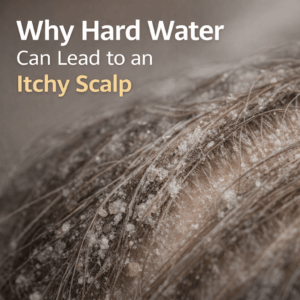
Why Hard Water Can Lead to an Itchy Scalp
An itchy scalp after showering is often misunderstood. Many people assume it’s caused by dryness, but in reality, it’s frequently the result of buildup and irritation.
Hard water contributes to that by:
- Leaving mineral deposits behind
- Making shampoo and even conditioning products less effective, which is often why people feel like their conditioner isn’t working
- Increasing residue from oils and products
- Creating an environment where irritation can thrive
When minerals mix with cleansers, they can create a residue that sits on the scalp—often leading to tightness, flaking, and that “never fully clean” feeling.
Over time, this buildup can disrupt the scalp barrier, making it more sensitive and prone to itching or irritation.
What We See in Our Center
In our work with men and women experiencing scalp concerns and hair thinning, we’ve seen firsthand how water quality can impact scalp health.
As shared in our recent feature in AARP:
“When those irritants are removed, we see fewer issues with flaking, itchiness and hair that feels brittle or dull. The difference in scalp comfort and hair manageability is often immediate.”
— Emmanuel Mroczka, Jeffrey Paul’s Hair & Scalp Specialists
This reflects what we consistently see in our center:
- Clients with eczema-prone skin noticing less post-shower tightness and redness
- Guests struggling with chronic scalp itching experiencing calmer, more hydrated skin
- Those with well water seeing some of the most noticeable improvements
When mineral buildup and irritants are reduced, the scalp often feels more balanced—and the hair becomes easier to manage.
Can a Shower Filter Help?
For many people, installing a shower filter is a simple first step.
These filters are designed to reduce chlorine and other impurities. While standard shower filters are not always able to fully remove hardness (calcium and magnesium), they can still help reduce exposure to irritants that affect the scalp and skin.
While a filter is not a cure-all, it can make a meaningful difference—particularly for those already dealing with scalp irritation.

But Here’s the Part Most People Miss
Even with improved water quality, existing buildup doesn’t just disappear.
If the scalp has already been dealing with:
- Mineral deposits
- Excess oil
- Product layering
- Inflammation
Then simply changing the water source may not fully resolve the issue. In many cases, the underlying buildup and irritation have already been present for some time.
This is where a more targeted approach to scalp care becomes important. In many cases, professional scalp treatments can help remove buildup, rebalance the scalp, and support a healthier environment for hair.

Understanding What Your Scalp Actually Needs
Every scalp is different.
Some need deeper cleansing and exfoliation. Others need support for irritation or imbalance. And in many cases, it’s not just one factor—it’s a combination.
That’s why we start with a ScalpCheck® evaluation, where we take a closer look at what’s happening at the scalp level and build a plan based on what we actually see—not guesswork.
Final Thoughts
If your scalp has been feeling itchy, irritated, or just not quite right, it’s worth looking beyond products alone.
Water quality, buildup, and scalp environment all play a role.
And sometimes, small changes—like improving your shower water or properly cleansing the scalp—can make a bigger difference than you’d expect.
The key is understanding what’s actually happening at the scalp level first—so the right approach can be taken.