When most people think about hair loss, alcohol doesn’t usually make the list of causes. But while alcohol itself doesn’t directly cause hair loss, the effects it has on your body — from disrupting sleep to depleting nutrients — can absolutely affect the health of your scalp and hair. Let’s explore what’s really happening beneath the surface.
1. Stress and Cortisol: The Hidden Connection
Stress is one of the most common internal triggers of hair loss. According to Harvard Health, elevated cortisol levels can push hair follicles into a resting phase — a process known as telogen effluvium — where shedding occurs more easily. When this happens repeatedly, it can lead to visible thinning across the scalp. High stress also disrupts hormone balance and scalp oil production, often resulting in increased itch, dandruff, or inflammation that further weakens hair growth.
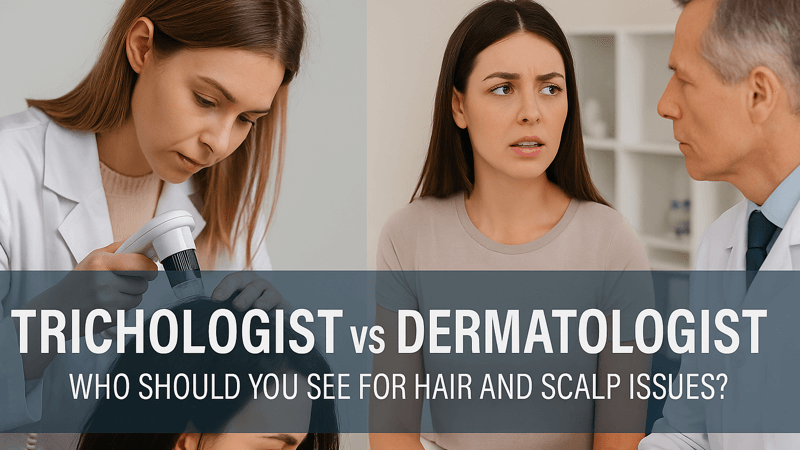
Are you experiencing dandruff, hair shedding, scalp itchiness, or oil buildup? You might be wondering if you should see a trichologist or dermatologist. Understanding the difference between a trichologist vs dermatologistis the first step to finding the right help for your hair and scalp issues.
Let’s break down the differences and help you decide who’s the right fit for your concerns.
Have you noticed more hair in your brush, shower drain, or on your pillow during certain times of the year? You are not alone. Seasonal hair shedding is a real and common experience, especially during the spring and fall months.
For many people, this increase in shedding is temporary. But in some cases, what looks like seasonal shedding may actually be a sign of an underlying scalp or hair-loss issue. Knowing the difference is important, and that starts with understanding what is normal, what is not, and when it is time to take a closer look.
Hair loss can feel overwhelming, but the good news is that in many cases, it’s treatable—and sometimes reversible. Whether you’re dealing with sudden shedding or gradual thinning, understanding the root cause is the first step toward recovery.
At Jeffrey Paul’s Hair & Scalp Specialists, we help clients uncover what’s really going on with their hair and scalp so they can make confident, informed decisions. Here’s what you need to know.
Watch as we take you through how you can get to the root of your hair loss and how a Trichologist can help…
How the health of your scalp can affect your hair loss,
What a Trichologist can do to help diagnose your problem and formulate solutions
The different treatments available and the importance of keeping a consistent treatment routine at home
The Problem…
If you suffer from dandruff, excessive scalp itch, hair loss or thinning and oily hair, you’re not alone. There are countless products on the market to help restore hair loss, but the root of the problem needs to be found. And this could involve the scalp.
Emmanuel Mroczka, a Trichology specialist at Jeffrey Paul’s Hair & Scalp Specialists who was interviewed by WKYC in Cleveland, Ohio, has helped with numerous scalp problems. One important element is to determine what is causing the hair loss problem to begin with. By performing a ScalpCheck®, experts can reveal the true reason and help you put those issues behind you.
In the video above, Senior Health Correspondent Monica Robins from WKYC takes you through the ScalpCheck® experience.
If you or someone you know is suffering from hair thinning or loss, scalp itch, or dandruff, book now to learn more about ScalpCheck®, an analysis to discover the true health of your hair and scalp.
Eight years ago, Rachel began experiencing anxiety-based hair loss. After doctor visits, blood tests and medications, Rachel wanted a more natural approach, and our team was there to provide support and the latest hair solutions infusing Italian-based 3D-technology that she needed.
Watch as Rachel’s full transformation of restoring her hair loss and her inner beauty of confidence that was lost with the loss of her hair.
Below you can watch each segment of Rachel’s Journey.
She got more than her hair back…she got her life back as well.
After being diagnosed with Grave’s Disease and suffering the side effects of this thyroid disorder and the medications associated with it, Linsey decided to seek help for her thinning hair. Too much of her life had been spent hiding and covering up, and she was ready to live her life again. After spending time with Hair & Scalp Specialists, a plan was put in place to help repair her beauty – both on the inside and out.
From the Consultation to determine the best solution for Linsey to the Design & Mold session, a personal blueprint was created specifically to meet her needs. To determine the best custom design solution, we had to consider her lifestyle, coverage needs, and maintenance requirements. These necessary conversations helped determine the best attachment method for Linsey, allowing her hair system to allow her to live her life without compromise! Watch Linsey’s story…
We would like you to meet Kristin. As a survivor of Stage 1 breast cancer, she is a fighter! In the midst of her battle, she lost her thick, blonde, beautiful hair to chemotherapy. She felt as if she had lost control of not only her body but also her her hair. For Kristin, even though she knew that hair didn’t define who she was, losing her hair was overwhelming, and she wanted to find a solution that would work for her.
Listen to Kristin’s story about gaining her self-esteem back with the help of our Hair Restoration Specialists.
In this episode of Hair Loss Solutions TV™, you will discover the following:
Andrea’s story
How Andrea has learned some very valuable life lessons: Live life victoriously, live in the moment, and live large!
The impact that Andrea’s new makeover
Having suffered severe burns and still dealing with the effects of it three years later, Andrea shares with us her story of hope, strength, and gratitude. This makeover was not only an honor to be a part of, but it was also the most inspirational story one can imagine. Andrea talks about living life victoriously, living in the moment, and living large.
As you’ll hear in the video above, life is not guaranteed, and Andrea discusses the importance of living life to its fullest by being grateful for what you have, not focusing on what you don’t possess. Sometimes it can be the little things that mean the most. So, live in the now. Don’t wait for a better time or a better situation; live large today!
Now Andrea is taking her life lessons and sharing them with others. And she is doing so with a beautiful head of hair! She not only looks beautiful, but she has gained confidence as well.
Did you know that not all hair is equal? As professionals, it is our job to educate you on what options are available for the best fit for you and your lifestyle. Today I want to discuss the three different types of hair my Team uses: Premium vs. Premium Plus vs. Virgin.
Our goal is to help our Guests have healthy, beautiful hair once again. But as you read above, not all hair is equal. Education is key to the success and longevity of any hair system! Having an understanding of the types of hair can help you when discussing your options with your hair professional.
Isaac Bracha, owner and president of the Hair and Compounds in Los Angeles, California, and a featured hair broker and expert in my book operates a research and development laboratory for replacement hair. He states, “…Replacement hair will best mimic its wearer’s hair if it is extremely close in diameter. Diameter affects the weight of the hair, the way it falls, and other important factors that will become obvious if there is a large discrepancy.” A hair restoration specialist can help determine the best solution for you.
In December 2014, Kaylee was diagnosed with brain cancer. She was immediately rushed into emergency surgery to remove the tumor, then started chemotherapy and radiation treatment at St. Jude’s Children’s Hospital in January 2015.
For a year and a half, Kaylee was without hair and would go to school wearing a hat to hide the hair loss. Even though she was winning her battle with cancer, it was hard to feel like a normal girl without her hair.
After finding Wigs For Kids and applying for a hairpiece, Kaylee now has a beautiful head of hair that helps her feel confident again. Now a year and half clean from cancer, Kaylee is an inspiration for kids all over the world who have lost their hair to cancer or another illness.
Ah, menopause! That natural biological process and inevitable rite of passage that all women experience at some point in their lives. And while every woman’s menopause experience is different, there are some common menopausal symptoms that cause the greatest disruption to everyday life. While hot flashes, mood swings and weight gain are expected during “the change,” many women are unaware and unprepared for the hair thinning and hair loss that can take place during this time. In fact, nearly 40 percent of women experience hair thinning during and after menopause.
For women going through menopause, the cause of hair loss is almost always related to hormonal
changes. The body produces less of the female hormones estrogen and progesterone, which are the main triggers for hair growth. When the levels of progesterone and estrogen drop, hair growth slows and hair tends to become thinner. Lifestyle changes, including diet and sleeping habits, can also take a toll. For women experiencing menopause, the added anxiety of hair loss can have devastating effects on one’s self-confidence and daily outlook.
A glimpse into the steps involved in finding the best solution for Maxie’s hair loss
How Maxie’s self-esteem has returned and she lives her life feeling beautiful on the inside and out
When you become a mother, many things in your life change. Your protective instincts kick in, you become an expert in time management, your sleep pattern changes, and so much more. It’s inevitable.
But hair loss is an unpleasantry that only affects some mothers. Our office coordinator Maxie experienced this first-hand after giving birth to her third child. Prior to having kids, she never imagined that hair loss would be a problem for her.
As Maxie describes in our video, she began to notice the changes in her hair’s texture, color and weight. She would find clumps of hair after taking a shower. Like others, she initially attributed this hair loss to aging and shrugged it off as one of life’s natural occurrences. But these changes weren’t caused by age; it was due to having children.
Imagine stepping into the shower to wash your hair and noticing patches of your healthy hair falling down your shoulders onto the ground around you, leaving spots of baldness on your head. For Claudia, a woman who was used to having a full head of healthy hair all her life, this nightmare became her reality.
It’s called Alopecia, or “spotted baldness” – a condition where your immune system mistakenly attacks the hair follicles, leading to patches of hair loss. There’s currently no cure for the condition, but there are treatments that can help.
In this episode of Hair Loss Solutions TV, you’ll hear about Claudia’s story of living with Alopecia and learn more about the condition and treatments available.