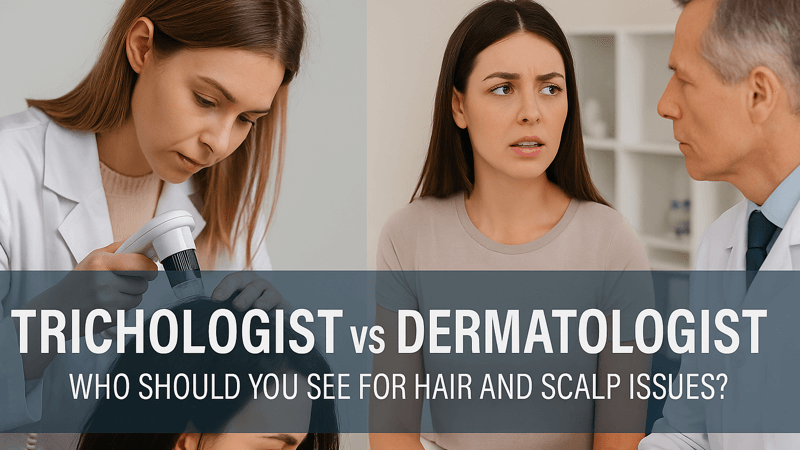
Are you experiencing dandruff, hair shedding, scalp itchiness, or oil buildup? You might be wondering if you should see a trichologist or dermatologist. Understanding the difference between a trichologist vs dermatologistis the first step to finding the right help for your hair and scalp issues.
Let’s break down the differences and help you decide who’s the right fit for your concerns.
Watch as we take you through how you can get to the root of your hair loss and how a Trichologist can help…
How the health of your scalp can affect your hair loss,
What a Trichologist can do to help diagnose your problem and formulate solutions
The different treatments available and the importance of keeping a consistent treatment routine at home
The Problem…
If you suffer from dandruff, excessive scalp itch, hair loss or thinning and oily hair, you’re not alone. There are countless products on the market to help restore hair loss, but the root of the problem needs to be found. And this could involve the scalp.
Emmanuel Mroczka, a licensed Trichology specialist at Jeffrey Paul’s Hair & Scalp Specialists who was interviewed by WKYC in Cleveland, Ohio, has helped with numerous scalp problems. One important element is to determine what is causing the hair loss problem to begin with. By performing a ScalpCheck®, experts can reveal the true reason and help you put those issues behind you.
In the video above, Senior Health Correspondent Monica Robins from WKYC takes you through the ScalpCheck® experience.
If you or someone you know is suffering from hair thinning or loss, scalp itch, or dandruff, book now to learn more about ScalpCheck®, an analysis to discover the true health of your hair and scalp.
Welcome to our Best of 2017 series. We’re counting down your favorite posts from Jeffrey Paul Blog and looking forward to some of the surprises we’re planning for 2018!
At Jeffrey Paul Salon, we have a team of experts to help you find the best hair solutions. We make sure that each hair transformation is customized to your unique needs. This process begins with a ScalpCheck to address any scalp issues you may have. Through our experienced staff, we can help you put your scalp issues behind you.
We want to know: What is holding you back from getting help with your hair thinning and loss?
Remember…Beauty & Change Begin Within,
Jeffrey Paul
The Problem…
If you suffer from dandruff, excessive scalp itch, hair loss or thinning and oily hair, you’re not alone. There are countless products on the market to help restore hair loss, but the root of the problem needs to be found. And this could involve the scalp.
Emmanuel Paul, a licensed Trichology specialist at Jeffrey Paul’s Hair & Scalp Specialists who was interviewed by WKYC in Cleveland, Ohio, has helped with numerous scalp problems. One important element is to determine what is causing the hair loss problem to begin with. By performing a ScalpCheck®, experts can reveal the true reason and help you put those issues behind you.
In the video above, Senior Health Correspondent Monica Robins from WKYC takes you through the ScalpCheck® experience.
We would like you to meet Kristin. As a survivor of Stage 1 breast cancer, she is a fighter! In the midst of her battle, she lost her thick, blonde, beautiful hair to chemotherapy. She felt as if she had lost control of not only her body but also her her hair. For Kristin, even though she knew that hair didn’t define who she was, losing her hair was overwhelming, and she wanted to find a solution that would work for her.
Listen to Kristin’s story about gaining her self-esteem back with the help of our Hair Restoration Specialists.
In this episode of Hair Loss Solutions TV™, you will discover the following:
Andrea’s story
How Andrea has learned some very valuable life lessons: Live life victoriously, live in the moment, and live large!
The impact that Andrea’s new makeover
Having suffered severe burns and still dealing with the effects of it three years later, Andrea shares with us her story of hope, strength, and gratitude. This makeover was not only an honor to be a part of, but it was also the most inspirational story one can imagine. Andrea talks about living life victoriously, living in the moment, and living large.
As you’ll hear in the video above, life is not guaranteed, and Andrea discusses the importance of living life to its fullest by being grateful for what you have, not focusing on what you don’t possess. Sometimes it can be the little things that mean the most. So, live in the now. Don’t wait for a better time or a better situation; live large today!
Now Andrea is taking her life lessons and sharing them with others. And she is doing so with a beautiful head of hair! She not only looks beautiful, but she has gained confidence as well.
Did you know that not all hair is equal? As professionals, it is our job to educate you on what options are available for the best fit for you and your lifestyle. Today I want to discuss the three different types of hair my Team uses: Premium vs. Premium Plus vs. Virgin.
Our goal is to help our Guests have healthy, beautiful hair once again. But as you read above, not all hair is equal. Education is key to the success and longevity of any hair system! Having an understanding of the types of hair can help you when discussing your options with your hair professional.
Isaac Bracha, owner and president of the Hair and Compounds in Los Angeles, California, and a featured hair broker and expert in my book operates a research and development laboratory for replacement hair. He states, “…Replacement hair will best mimic its wearer’s hair if it is extremely close in diameter. Diameter affects the weight of the hair, the way it falls, and other important factors that will become obvious if there is a large discrepancy.” A hair restoration specialist can help determine the best solution for you.
In December 2014, Kaylee was diagnosed with brain cancer. She was immediately rushed into emergency surgery to remove the tumor, then started chemotherapy and radiation treatment at St. Jude’s Children’s Hospital in January 2015.
For a year and a half, Kaylee was without hair and would go to school wearing a hat to hide the hair loss. Even though she was winning her battle with cancer, it was hard to feel like a normal girl without her hair.
After finding Wigs For Kids and applying for a hairpiece, Kaylee now has a beautiful head of hair that helps her feel confident again. Now a year and half clean from cancer, Kaylee is an inspiration for kids all over the world who have lost their hair to cancer or another illness.
Ah, menopause! That natural biological process and inevitable rite of passage that all women experience at some point in their lives. And while every woman’s menopause experience is different, there are some common menopausal symptoms that cause the greatest disruption to everyday life. While hot flashes, mood swings and weight gain are expected during “the change,” many women are unaware and unprepared for the hair thinning and hair loss that can take place during this time. In fact, nearly 40 percent of women experience hair thinning during and after menopause.
For women going through menopause, the cause of hair loss is almost always related to hormonal changes. The body produces less of the female hormones estrogen and progesterone, which are the main triggers for hair growth. When the levels of progesterone and estrogen drop, hair growth slows and hair tends to become thinner. Lifestyle changes, including diet and sleeping habits, can also take a toll. For women experiencing menopause, the added anxiety of hair loss can have devastating effects on one’s self-confidence and daily outlook.
In this episode of Hair Loss Solutions TV™, you will discover the following:
How Maxie, like so many others, began to notice changes in her hair’s texture, color, and weight
What Hair & Scalp Specialists can do to help with your hair thinning and loss
A glimpse into the steps involved in finding the best solution for Maxie’s hair loss
How Maxie’s self-esteem has returned and she lives her life feeling beautiful on the inside and out
When you become a mother, many things in your life change. Your protective instincts kick in, you become an expert in time management, your sleep pattern changes, and so much more. It’s inevitable.
But hair loss is an unpleasantry that only affects some mothers. Our office coordinator Maxie experienced this first-hand after giving birth to her third child. Prior to having kids, she never imagined that hair loss would be a problem for her.
As Maxie describes in our video, she began to notice the changes in her hair’s texture, color and weight. She would find clumps of hair after taking a shower. Like others, she initially attributed this hair loss to aging and shrugged it off as one of life’s natural occurrences. But these changes weren’t caused by age; it was due to having children.
Imagine stepping into the shower to wash your hair and noticing patches of your healthy hair falling down your shoulders onto the ground around you, leaving spots of baldness on your head. For Claudia, a woman who was used to having a full head of healthy hair all her life, this nightmare became her reality.
It’s called Alopecia, or “spotted baldness” – a condition where your immune system mistakenly attacks the hair follicles, leading to patches of hair loss. There’s currently no cure for the condition, but there are treatments that can help.
In this episode of Hair Loss Solutions TV, you’ll hear about Claudia’s story of living with Alopecia and learn more about the condition and treatments available.
Join us for our LIVE, FREE event – “Let’s Talk Hair,” taking place on Sunday, August 6, from 1:00pm-3:00pm at the Jeffrey Paul Hair Restoration Center (21080 Lorain Rd., Fairview Park, OH). This event will include discussions about all of your hair and scalp questions.
Talk to real guests who’ve undergone hair transformations and learn about the exclusive four-step ScalpCheck® process, the non-surgical Second Scalp hair restoration technology and more. There is no cost for admission. For more details and to register for the event, visit HairScalp.com/LetsTalk or call 440-333-8939.
Bring yourself, a friend, and the questions you may have. Enjoy some light appetizers and refreshments. Plus, we will have a free gift for each person who attends!
Join us Sunday, August 6th for the “Let’s Talk Hair” event and learn about the latest and most technologically advanced hair and scalp solutions.
The “Let’s Talk Hair” event is your opportunity to have your hair and scalp health questions answered. This exclusive event is for men and women to come in and not only discover what we’re all about and what we have to offer, but also talk to actual guests who have successfully undergone hair and scalp transformations.
In the video above,certified Trichologist and “Let’s Talk Hair” guest speaker Emmanuel Paul gives a brief preview of what’s to come at the August 6th live event. Paul will be presenting the exclusive ScalpCheck®, a four-step Trichological analysis designed to help discover not only what each guest’s hair issues are, but also which treatments are best to put those issues behind them. During the event, guests will get to see the center’s exclusive ScalpCheck® in action!
Just bring yourself, a friend, and the questions you may have. Enjoy some light appetizers and refreshments. Plus, we will have a free gift for each person who attends!
In this episode of Hair Loss Solutions TV™, you will discover the following:
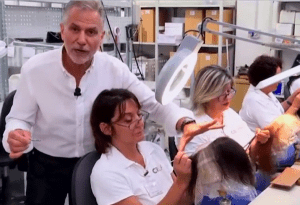
Tour of the Cesare Ragazzi Laboratories in Bologna, Italy, where CNC 3-D prosthetic hair pieces are created [0:40]
The process of mapping and casting the head to create the molding to be transformed with 3-D Printing into a Hair Replacement [0:55]
The 39 steps involved in the Cesare Ragazzi Labs to produce a second scalp with hair to replicate growing hair [1:50]
The DNA and quality control checks performed to ensure that the hair and scalp are of the highest quality [5:22]
The art of injecting one hair at a time into the second scalp [8:15]
What is CNC 3-D Prosthesis?
By using the most technologically advanced, dermatologically-tested, non-invasive hair replacement system found anywhere today, this “Second Scalp” that allows people suffering from hair thinning and loss to enjoy a completely custom made full head of beautiful hair. After taking a mold of your scalp and mapping the areas of hair thinning and loss by a licensed certified center, the Cesare Ragazzi team is then able to take this mold and leverage 3-D Printed Technology to replicate a model of your scalp, perfectly matching the contour and shape of the hair loss site. The model is produced with breathable biopolymer material that becomes your customized “second scalp.”
The prosthesis is hypoallergenic and secured with a dermatologist-approved adhesive and allows you to live a normal life, including swimming, showering, exercising, etc. With a base consisting of antifungal, antimicrobial material, and biomedical materials, it adapts to your body temperature and allows sweat and heat to pass through. Only virgin, unprocessed hair is used in the CNC prosthesis, which makes it the highest quality of human hair. With the CNC 3-D prosthesis, you can truly live your life without compromise!
In this episode of Hair Loss Solutions TV™, you will discover the following:
What Alopecia is and how it affects people of all ages
How Jeffrey Paul, founder of Wigs for Kids, works with Italian company, Cesare Ragazzi, who creates advanced prosthetic hair pieces
How the hair piece is securely attached to ensure proper placement and the dermatologically-approved adhesive used
How Annie regained not only a beautiful head of hair, but also her confidence with the help of the Cesare Ragazzi’s 3D technology and printed hair systems
In the video above, Annie faced Alopecia at a young age and looked for solutions to help restore her confidence. When she turned to Wigs for Kids, a nonprofit organization that provides hair systems to children with medically-induced hair loss at no cost, she not only received a full head of natural-looking hair, but she also regained her confidence. She has always been beautiful, but now she feels it as well! Annie has taken her life’s journey with hair loss and used it as a platform to share her story of courage and hope to others. Check out what Annie considers to be her most treasured possession. Click here to listen to her incredible story!
Hair loss for both men and women is common, affecting more than 75% of men and nearly two-thirds of women at some point in their lifetime. For many, any degree of hair loss can be a traumatic experience. This simple truth essentially drives a multi-billion hair loss treatment industry filled with products and treatments claiming to cure hair loss. Understanding hair growth and accurately measuring and diagnosing the cause of hair loss can take the unknown out of treatment and can curb or delay future hair loss.
It is a normal and healthy part of hair growth to lose some hair each day. Men with healthy hair shed between 60 and 80 strands each day, while women normally lose up to 100. But when does it all become too much? Typically, it takes 50% loss in hair density for hair loss to become noticeable to the naked eye. As with any medical condition, early detection can be key in effectively treating hair loss. Once hair loss progresses to a certain point, treatment becomes more difficult and costly in achieving good results.
If you’re wondering if you are experiencing hair loss, the rate at which you are losing hair, or even the effectiveness of a hair loss treatment regimen, wonder no more.




 changes. The body produces less of the female hormones estrogen and progesterone, which are the main triggers for hair growth. When the levels of progesterone and estrogen drop, hair growth slows and hair tends to become thinner. Lifestyle changes, including diet and sleeping habits, can also take a toll. For women experiencing menopause, the added anxiety of hair loss can have devastating effects on one’s self-confidence and daily outlook.


 The model is produced with breathable biopolymer material that becomes your customized “second scalp.”